
Over the past decades human life has going through many technological changes that made a big development in the world. Which in two words we call it the industrial revolution. First time I found out that this terminology was on 25 October with Reef Alawad, Jack Molony and Anthony Gavin. Then my journey to learn a new concept in life has begun.
Starting with Reef, she is a Saudi woman whose working in Accenture company for seven years. Within this experience she supported different governments across the region, to help them implementing technology in their sectors for an economic outcome. Her speech was concerning about the latest phase of industrial revolution which focuses on technology, then about digital age and three biggest agendas of specific digital trends she has seen in government. Moving to the Irish business networkers Anthony & jack, in 2015 they have settled a voluntary group to introduce business networking for companies and business professionals between Saudi Arabia and Ireland. The reason behind it is to bring people togather to share experiences, learn and come up with business opportunity for each other. Anthony is a monetary agency at SAMA and the chairman of this group in Saudi, where jack is technology consultant at payment services company. Jack presentation was about explaining the most important events that happened about economic impact of the fourth industrial revolution. He is mainly focusing on the marketing & financial implications of the fourth industrial revolution.
Industrial revolution waves
According to (Mokyr, 2003, p50) “The term industrial revolution is normally reserved for a set of events that took place in Britain roughly from 1760 to 1830”. That is how it is started; industrial revolution is the process of economic expansion from using hand production to machines. In a quote by T.S. Ashton he described the industrial revolution as “a wave of gadgets that swept Britain”. Moreover, for the long term these historical events are a result of variety of technological and social changes had affected all western Europe economy so it did not limited to England (Mokyr, 2003). Thus, human history in technology was running through a lot of digital waves, that had affected our lives in a massy way. Before the industrial revolution everything was by hand, nowadays we have exchanged a lot of human activities with technology until we became not able to dispense it. Referring to reef and Jack, the waves had move along from Mechanization where this wave has helped people in their job roles and it was all about production, electrification where electricity had a huge impact on work productivity, informatization where computers used in the industry tell intellectualization the era of digital age such as technology like artificial intelligence, blockchain and robotics & machine learning.
Welcome to the 4.0 industry
We are at the beginning of a new era where we live in a point of emerging technology and the real physical world together as reef had stated, which it is titled as 4.0 industry. It is the “methodology to generate a transformation from machine dominant manufacturing to digital manufacturing.”(Oztemel, E. and Gursev, S., 2018.).Therefore, we can expect that technology will be the foundation of societies in the future. Jack had discussed what made this industrial revolution, in the first place it impacted with a numerous of technology that will change our lives. For instance, Artificial intelligence and robotics & machine learning.
Artificial intelligence & Robotics
The fourth wave just started with artificial intelligence, big data and robots as reported by (Park, S.C., 2017). Therefore, it is agreeing with what jack said about artificial intelligence, that it is the most important significant technology in 4.0 industry. As it has a huge impact on the economy for example, paypal has developed computers security protection by developing it from AI as it helped to react to harmful actions immediately. Also, John Deer has built AI on their equipment that led to no longer need of human beings. So, this phenomenon made the connect between machines and machines possible.

Figure 1
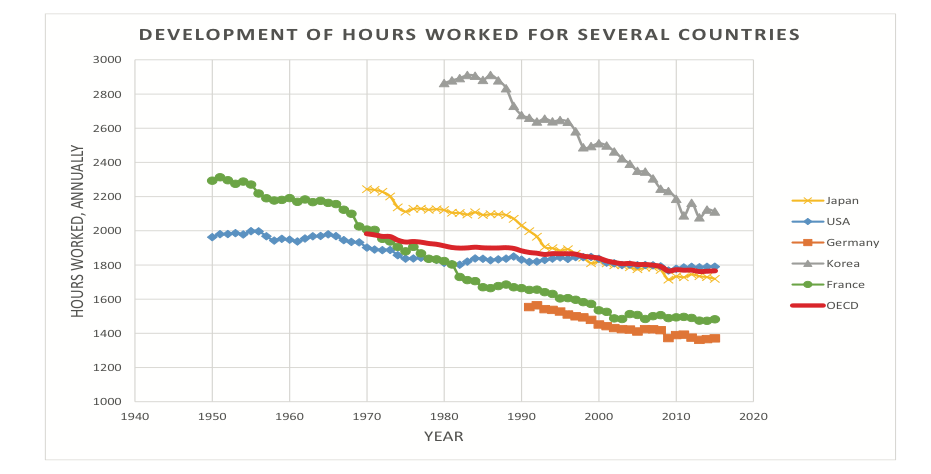
Figure 2
Which will move us to robots, in line with Sang and Chul Park AI, big data and robotics can contribute with automation to increase productivity, subsequently, robots can use AI to make decisions on a complicate process by themselves. Consequently, jack’s point of view was right, that robotics and automation today can take human labor place. As shown in the figures unemployment in the past years has been increasing, “the mpirical evidence shows that unemployment fluctuated but its average rate remained about the same for a century and a half (see Figure 1). However, at the same time, the hours worked, annually, decreased substantially in OECD countries (see Figure 2)” (Vermeulen, B., Kesselhut, J., Pyka, A. and Saviotti, P.P.) which may lead to a covert technological unemployment that could illustrate us the negative side of these technologies.
Agenda of digital trends
Reef had explained the most important digital trend in government which is focusing on citizen experience. “Digital technologies have become a kind of a channel for the exchange of new types of professional knowledge and introduction of innovative developments directly into the work of the government” (Kosorukov, A.A., 2017). Currently internet is an essential thing for citizens everyday life especially in the Arab world as shown in figure 3. Therefore, building a strong positive experience through their journey with government is important. With 2030 vision the government direction had completely changed in an efficient way, so citizen experience will be in a good hand with technology. Moreover, satisfying citizen will increase productivity for an economic outcome value eventually.

All in all, industrial revolution had shaped our world with digital transformation in an incredible way. Even though it has some disadvantages, in the end it helped us to live in a growth economy. In the era technology is more than the basic use of mobile devices, everything from countries to individuals are connected to the digital age.

 Eureka